In the AI Era, Your Real Asset Is Not Better Answers, but a Library of Solved Problems
AI makes answers cheap. Personal growth does not come from receiving better answers. It comes from turning real problems into experiments, results, reflection, and reusable know-how.
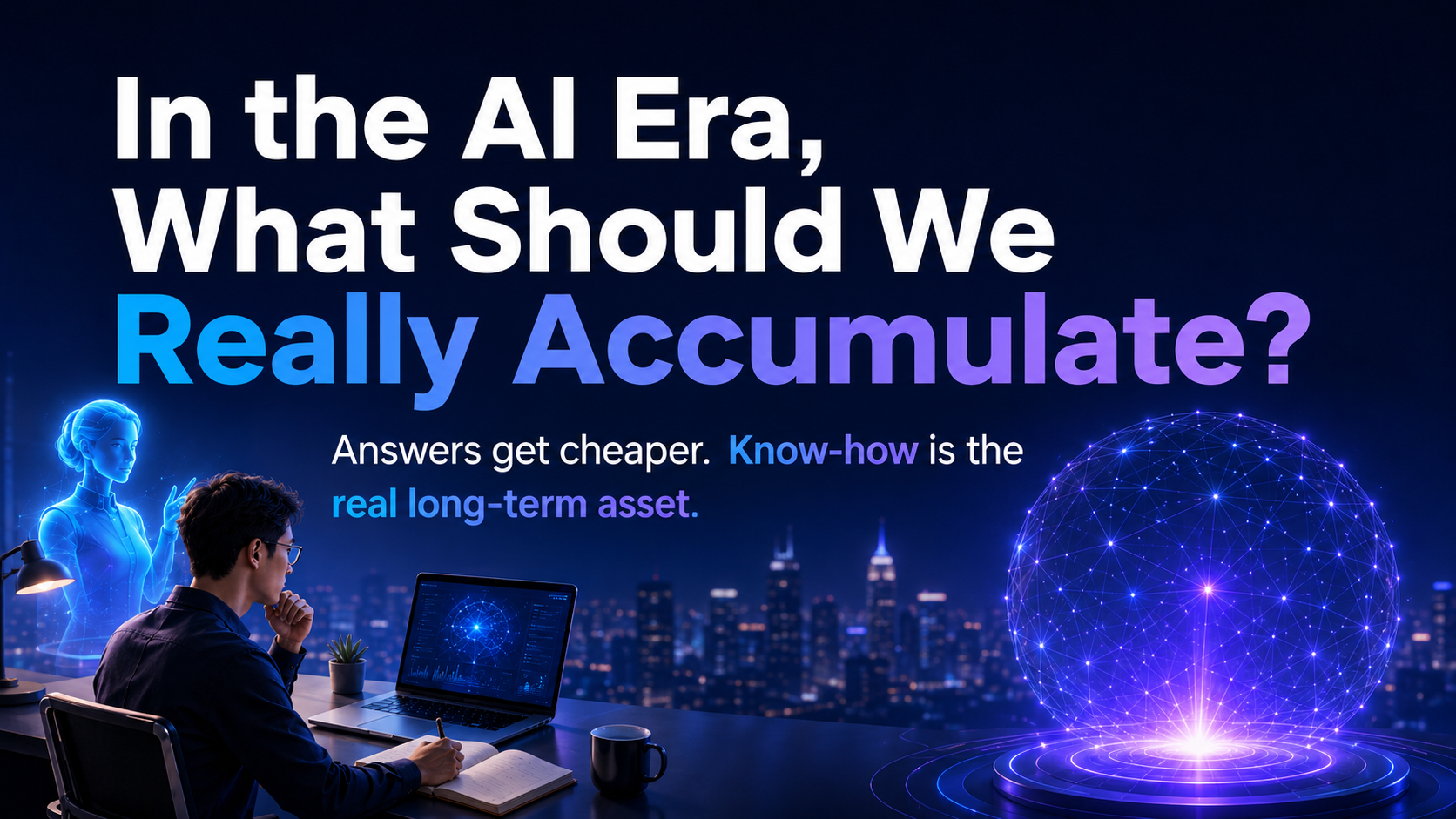
AI is changing the environment for learning.
In the past, when we did not understand something, we usually learned through work: a project, a difficult task, a leader, a mentor, a colleague, or a long trail of Google searches. We collected clues, compared different answers, tried something, failed, asked again, and slowly built experience.
Today, a large part of that process can be compressed into one prompt.
ChatGPT, Claude, Gemini, and agentic tools can explain concepts, summarize documents, write code, compare options, draft strategies, and search across large amounts of information. In practice, it feels as if everyone can have a very strong mentor sitting next to them: patient, fast, widely read, and available at any time.
That is obviously powerful.
But it also raises a harder question:
If answers become this easy to obtain, how should individuals grow?
This reminds me of an early work experience.
When I first started working, I had a very strong leader. His coding ability was excellent. When I ran into a problem and asked him for help, he could often identify the issue quickly and even write the code for me.
In the short term, that was great. The problem was solved. The project moved forward. I avoided many mistakes.
But the important part of the story is what happened next: I would roll back everything he wrote, keep his thinking as a reference, and implement the solution again by myself. Even if he had already given me the answer, I still needed to do it with my own hands.
Because if someone simply hands me the final answer every time, and I do not go through the process again, I do not really gain much.
I need to experience the questions myself:
- Why did this fail?
- What alternative solutions exist?
- Why does this solution work here?
- Under what conditions would it stop working?
- How should I judge a similar problem next time?
A problem being solved does not mean the experience has become mine. It starts becoming mine only after I reconstruct it myself.
AI creates the same risk, only at a much larger scale.
AI can be stronger, faster, and more patient than that leader. It will not get annoyed by basic questions. It will not be too busy to respond. But if we only use AI as an answer machine, we may become better at receiving outputs while becoming worse at building the experience that makes those outputs useful.
What We Actually Accumulate Is Not Knowledge Points, but Problem-Solving Experience
Looking back at years of work, I increasingly believe that a person’s value is not mainly about how many facts they know.
Knowing a tool, a framework, or an industry term is useful. But the deeper value comes from something more contextual:
- What real problems have I solved?
- What constraints and variables existed at the time?
- How did I define the core problem?
- What assumptions did I make?
- What solutions did I try?
- What worked, what failed, and why?
- What judgment did I form after seeing the result?
This is what I mean by know-how.
It is not a paragraph that can be copied and pasted. It is not a capability automatically gained after reading an article. It is closer to a system for solving new problems by drawing on previous cases, variables, failures, and results.
The same question can have very different answers depending on the company, market cycle, team capability, budget, timeline, user expectations, and risk tolerance.
Experienced people are valuable because they do not only know an answer. They know the conditions behind the answer. They know when it applies, when it breaks, which variables matter, and which small-looking details can change the outcome.
That is difficult to get from search alone.
It is also difficult to get from AI alone.
AI can give you a strong average answer. But your own know-how has to grow through real problems, real attempts, and real results.
When Answers Become Cheap, Experience Becomes More Visible
Google made information cheap. AI is making answers cheap.
That means many old advantages will be compressed: knowing where to find information, being able to write a basic draft, producing boilerplate code, or summarizing a topic quickly.
Microsoft’s 2025 Work Trend Index uses the phrase “intelligence on tap.” The idea is that intelligence is becoming abundant, scalable, and available on demand. The same report argues that more people will need to become “agent bosses”: people who build, delegate to, and manage agents to amplify their own impact.
This matters because when intelligence becomes infrastructure, human differences do not disappear. They move to another layer.
In the past, the difference might have been:
- Who knows more?
- Who searches faster?
- Who can write the first version?
In the AI era, the difference is more likely to be:
- Who can define the right problem?
- Who can break it into testable assumptions?
- Who knows what counts as a real result?
- Who can judge whether an AI answer fits the current context?
- Who can turn AI output into action?
- Who can learn from the outcome and update their judgment?
Workday’s 2025 global research report makes a similar point from another angle. It reports that 93% of active AI users agree that AI lets them focus more on higher-level responsibilities such as strategy and problem solving. It also reports that 83% of respondents believe AI will elevate the importance of uniquely human skills and enhance human creativity.
In other words, AI does not remove the need for growth. It pushes growth to a higher level.
If AI can draft the first version of a strategy, you need to become better at judging whether the strategy is good.
If AI can generate code, you need to understand architecture, boundaries, testing, maintenance cost, and risk.
If AI can summarize materials, you need to know which materials matter and which are noise.
Once low-level answers become cheap, the scarce capability is the ability to place answers inside real problems and get results.
We Need a Better Way to Manage Knowledge After Answers Become Cheap
This is why I have become more interested in personal growth tools.
We already have many ways to record information: Markdown, Word documents, spreadsheets, Notion, Feishu docs, and personal knowledge bases. They are useful, but simply recording what we have read is not enough.
A knowledge base can easily become a warehouse.
Today we save an article. Tomorrow we bookmark a link. The day after that we write down a thought. The amount of content increases, but very little of it enters action, decision-making, or review. In the end, it becomes a list of things we once found interesting, not a system that helps us grow.
A more valuable record should not only ask:
What does this article say?
It should ask:
What judgment did this change? What type of problem can it help me solve? Did I use it in a real action? What was the result?
For example, if I read an article about AI agents, it should not only become a saved link. It can become a capability record:
- What problem does it relate to? For example: how can an individual use agents to increase work output?
- What assumption does it suggest? For example: more workers may need to manage groups of agents.
- How will I test it? For example: use agents to complete one research, writing, and publishing workflow.
- What result did I get? For example: how much time was saved, whether quality improved, and where human intervention was still required.
- Where can this experience transfer? For example: content production, product research, coding, customer support, or internal operations.
At that point, the record is no longer just knowledge storage. It becomes a capability asset.
I increasingly think the next personal growth system should be a capability library, not only a knowledge base.
A knowledge base answers: what do I know?
A capability library answers: what have I solved?
A Capability Library Should Record Problems, Variables, Assumptions, Solutions, Results, and Review
If we want to turn know-how into an asset, the record needs several dimensions.
First: the problem.
Do not record “I learned about AI agents” in a vague way. Record the actual problem: what was I trying to solve? Why did it matter? Was it a product, engineering, marketing, operations, management, business, creative, or personal growth problem?
Second: the variables.
No problem exists in isolation. Budget, time, team capability, market stage, technology maturity, user awareness, and resource constraints all affect the solution. Experience without variables easily becomes empty advice.
Third: the assumption.
Why did I think this approach might work? What judgment was behind it? If the assumption was wrong, how would the result change?
Fourth: the solution.
What exactly did I do? What tools did I use? What steps did I take? Which part did AI handle, and which part did I keep for human judgment?
Fifth: the result.
“Feels good” is not enough. The result should have some evidence: completion, time saved, conversion, quality, adoption, feedback, or failure signals.
Sixth: the review.
What did I learn? What would I do differently next time? Which parts can transfer to other contexts, and which only worked under this specific condition?
After enough records like this, a person gradually builds a map of their own capabilities.
For example, if I have never solved problems around user growth, pricing, retention, prioritization, or cross-functional coordination, then my product capability in those areas should not be rated very high. Not because I have read too few articles, but because I do not yet have enough proven paths.
But if I have handled many engineering problems around architecture, performance, deployment, collaboration, code quality, and automation, and each one has results and review, then that part of my capability asset is thicker.
This is more honest than a resume label.
It does not say “I am a product manager” or “I am an engineer.” It asks: what problems have I actually solved, how complex were they, and can the experience transfer to new situations?
When Work Does Not Give You Enough Problems, Learn to Create Your Own
Traditionally, we relied on work to give us problems.
A company has projects. A leader assigns tasks. Customers create requirements. Teams run into conflicts. We grow inside those pressures because work gives us problems, constraints, collaborators, and feedback.
But work does not always give us the best growth problems.
Sometimes the problems are too narrow. Sometimes they are too repetitive. Sometimes the organization does not encourage experimentation. Sometimes we want to build cross-industry or cross-domain experience, but our current role does not provide those opportunities.
AI changes this.
We can use AI to create more problems for ourselves. We can use it to explore a field, break down assumptions, gather materials, design small experiments, generate alternative solutions, simulate opposing views, and help us review results.
The best use of AI is not only:
Please finish this task for me.
A better use is:
- Help me find the problem.
- Help me break it down.
- Help me gather materials.
- Help me design an experiment.
- Help me generate multiple solutions.
- Help me review the result.
- Help me turn this experience into a capability record.
But the most important step cannot be skipped: you still need to try something and get a result.
Without action and result, AI gives you only an answer.
With action and result, AI can help turn the answer into experience.
This may be one of the most important directions for personal growth in the next stage: move from passively receiving tasks to actively creating problems; from waiting for work to provide experience to designing your own experiments; from recording knowledge to accumulating verifiable know-how.
The Valuable Person Is the One With Cross-Context Know-How
So if the question is how individuals should develop as AI and agents advance, my answer is not “learn one specific tool” or “memorize a set of prompt templates.”
Tools will change. Models will change. Agent interfaces will change.
The deeper direction is this:
Use AI to define problems faster, form assumptions faster, run experiments faster, get results faster, and then turn those results into your own capability library.
The more valuable person is not necessarily the one who asks AI the most questions. It is the one who uses AI to accumulate real experience faster.
That person will have many cases in hand: under different market conditions, with different resource constraints, collaborating with different people, facing different variables, they tried different solutions, got different results, and formed their own judgments.
Together, those cases become know-how.
AI can help us approach answers faster.
But growth is not the answer itself.
Growth is going through a problem, getting the result, seeing the variables clearly, reviewing both failure and success, and then facing the next problem with better judgment.
That ability may become one of the most important personal assets in the AI era.
References
- Workday, Elevating Human Potential: The AI Skills Revolution / “New Global Research from Workday Reveals AI Will Ignite a Human Skills Revolution”: https://newsroom.workday.com/2025-01-14-New-Global-Research-from-Workday-Reveals-AI-Will-Ignite-a-Human-Skills-Revolution
- Microsoft, The 2025 Annual Work Trend Index: The Frontier Firm is born: https://blogs.microsoft.com/blog/2025/04/23/the-2025-annual-work-trend-index-the-frontier-firm-is-born/