Digital Employees Are Starting to Work, but the Hard Part Is Not Replacing People
Digital employees are moving from marketing language into early production use. But the real challenge is not whether AI can replace a job title. The challenge is whether AI can receive tasks, keep state, deliver outcomes, stay auditable, and collaborate inside a real organization.
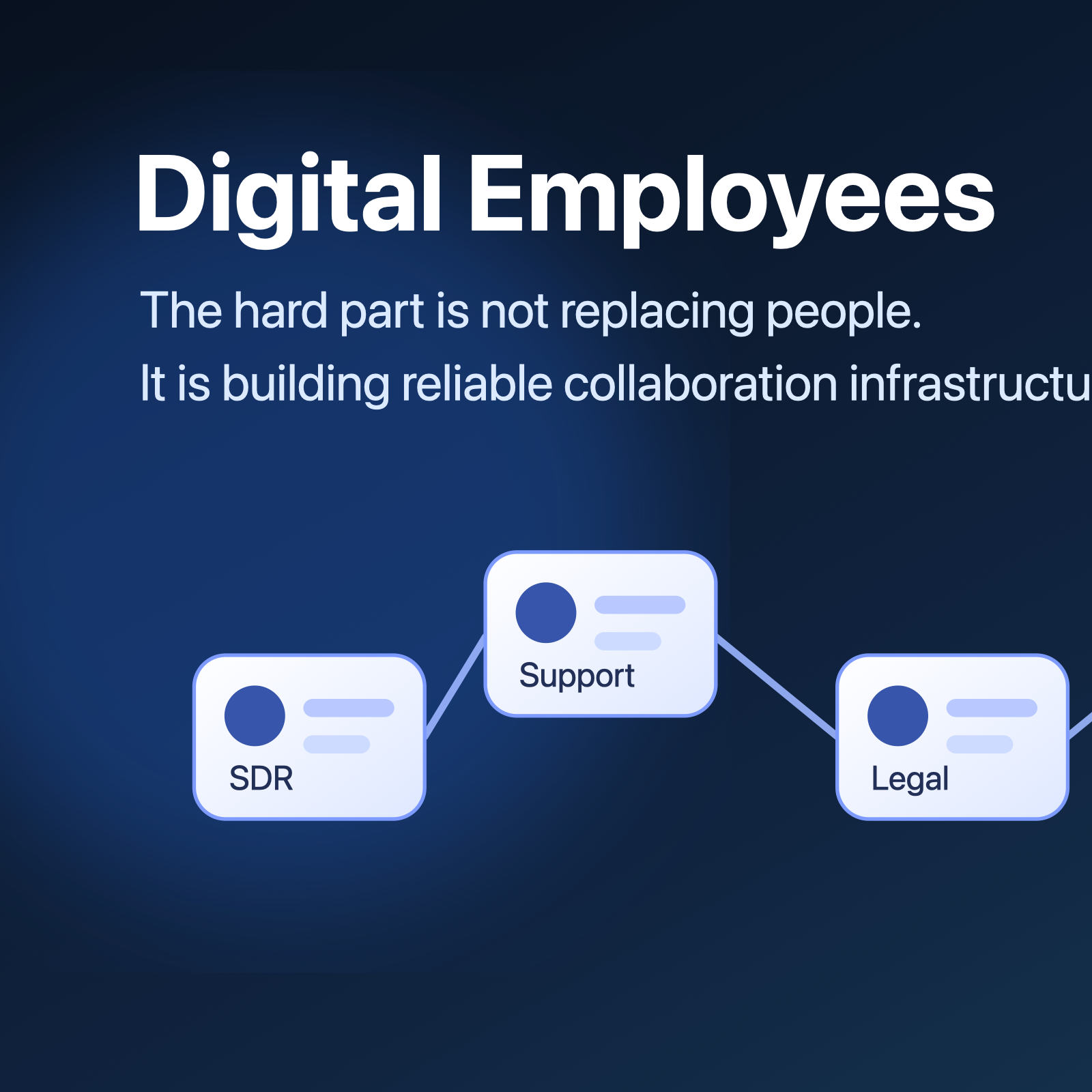
“Digital employee” is becoming a popular phrase again.
A few years ago, it usually appeared in the context of RPA, customer-service bots, or virtual avatars: a bot that filled in forms, an online support widget, or a digital human that could read scripts or appear in livestreams.
Today the same phrase is attached to a different set of ideas: AI employee, digital worker, AI agent, AI teammate.
The words sound similar, but the direction has changed.
The older version of a digital employee automated an action. The new version wants to own a more complete work outcome: finding leads, writing emails, making calls, resolving customer issues, searching legal documents, fixing code, organizing company knowledge, or pushing a business process forward.
After looking at a group of overseas and Chinese companies in this space, my current view is this:
Digital employees have moved from concept marketing into early production deployment, but they are not mature enough to fully replace complete roles. Overseas companies are more aggressively selling “hireable vertical agents.” In China, the mainstream form is still RPA + LLM, customer service and marketing automation, office automation, enterprise knowledge QA, and low-code agent platforms.
The more interesting question is not “will AI replace this job?”
It is that software delivery itself is changing: from selling tools to selling work, from charging by seats to charging by tasks or outcomes, and from humans operating software to software entering the division of labor inside organizations.
Overseas: Digital Employees Are Being Packaged as Hireable Roles
A common pattern among overseas AI employee companies is that they do not want to describe themselves as “tools.”
11x is explicit: it says it sells work, not software. Its digital worker Alice is an AI SDR that handles prospect research, multichannel outreach, and personalization. Its phone agent handles inbound lead qualification and outbound calling. 11x announced a $24 million Series A led by Benchmark in 2024.
Artisan is even more direct. It calls its products AI employees. Its first employee, Ava, is an AI BDR that finds leads, researches them, writes and sends emails, and books meetings. Artisan announced a $25 million Series A in 2025 and became known for the “Stop hiring humans” billboard. But the company’s own explanation is more nuanced: the target is not every part of human work, but the most repetitive and draining parts of outbound sales.
Sierra is focused on customer-service AI agents. The important part is not only the product, but also the pricing model. Sierra openly discusses outcome-based pricing: customers pay when the agent completes a valuable outcome, such as resolving a conversation, saving a cancellation, or completing an upsell. That pushes the agent away from being “another software seat” and toward being a measurable business unit.
Decagon is also in customer experience. It announced $250 million in funding at a $4.5 billion valuation, with customers including Avis Budget Group, Block, and Deutsche Telekom. Its language is not traditional chatbot automation, but “concierge customer experience”: more proactive, more personalized, and more focused on resolution.
Harvey represents the legal vertical. It announced a $300 million Series E at a $5 billion valuation. Legal work is naturally suited for vertical agents: dense text, high search requirements, professional standards, compliance constraints, and expensive expert time. Harvey is not a generic assistant. It embeds AI into real workflows for law firms and enterprise legal teams.
Cognition’s Devin is another important example. It presents Devin as an AI software engineer that can use a shell, code editor, and browser in a sandboxed environment, work on GitHub issues, debug, deploy, and learn unfamiliar technologies. The core question here is not whether AI can write code. It is whether it can reliably and audibly participate in the software engineering workflow.
Glean, Microsoft Copilot Studio, Salesforce Agentforce, and Moveworks represent another path. Instead of defining a single AI job title first, they give enterprises a platform to create and manage agents inside their own knowledge, permissions, workflows, CRM, IT, HR, and service-desk systems. Glean announced a $150 million Series F at a $7.2 billion valuation in 2025, and said Glean Agents already powers more than 100 million annualized agent actions. Microsoft describes agents as the new apps for an AI-powered world. Salesforce Agentforce describes its platform as a way to deploy digital labor safely for customers, suppliers, and employees.
So the overseas market can be roughly divided into two paths.
The first path is role-based digital employees. These companies start from a clear job category: SDR, BDR, customer support, legal assistant, software engineer. Their pitch is not “we help you become more efficient,” but “you can hire this AI to do this work.”
The second path is enterprise agent platforms. These companies do not necessarily promise to replace a specific role. Instead, they help companies build agents within their own data, permissions, systems, and workflows. Their value is governance, integration, security, and lifecycle management.
Both paths matter. The first feels more like a new species. The second is easier to adopt inside large enterprises.
China: More Often an Upgrade of Existing Enterprise Software
The Chinese market also talks about digital employees, but the implementation path is more pragmatic.
The mainstream form today is not “one AI employee owns a complete role.” It is usually a combination of several capabilities:
- RPA + LLM: making system operations, data entry, approval flows, finance, HR, reconciliation, and reporting more intelligent.
- Customer service, marketing, and CRM agents: automating support, agent assist, outbound calls, quality inspection, and sales follow-up.
- Office collaboration AI: improving documents, meetings, approvals, knowledge bases, and IM-based workflows.
- Enterprise knowledge QA and agent platforms: letting companies build agents on top of their own data and tools.
- Digital humans and avatars: useful for interaction, voice, and video, but not necessarily responsible for process execution.
Baidu Qianfan, Alibaba Cloud Bailian, Tencent Cloud ADP, and Huawei Cloud Pangu/MaaS are infrastructure-style players. They provide models, RAG, MCP, workflows, multi-model management, and low-code agent development platforms. Their platform capabilities are strong, but enterprises still need to define the actual workflow and business scenario.
DingTalk, Feishu, and Coze represent the office-collaboration entry point. They are closer to where work actually happens: documents, meetings, approvals, IM, knowledge bases, and project collaboration. But office AI has a key limitation: it can be useful without being accountable. If an agent only answers questions, summarizes documents, or generates content, it is still an assistant. It starts to resemble an employee only when it can receive tasks, keep state, move a process forward, accept review, and leave records.
Laiye, Cyclone Robotics, Encoo, and AI-Indeed represent the RPA and intelligent automation path. This is probably the most mature landing base for “digital employees” in China, because many enterprise tasks are indeed cross-system operations: copying, pasting, checking, entering, reviewing, and moving data through processes. The challenge for RPA companies is that they understand processes, but they may be squeezed by cloud model platforms and office entry points. The future competition is not only who can click buttons. It is who can understand context, plan steps, handle exceptions, and deliver results back to the business.
Udesk, Ronglian Cloud, and SalesEasy are examples of customer-service, marketing, and CRM vendors. This may be the clearest commercialization path because the metrics are concrete: response time, conversion rate, quality score, complaint rate, follow-up rate, and cost reduction.
So if the question is whether China’s digital employee market is still mainly RPA + LLM, customer service, marketing, and office automation, my answer is yes.
More precisely, many Chinese “digital employee” products today are not yet a new organizational form. They are existing enterprise software upgraded and repackaged for the LLM era. That is valuable, but it is still one layer away from a real agent company.
Maturity: From Answering, to Delivering, to Collaborating
I find it useful to divide digital employees into four stages.
1. RPA: Software Clicks Buttons
This stage solves repetitive operations: logging into systems, copying data, filling forms, downloading reports, reconciling data, and sending notifications.
It does not need deep business understanding. If the process is stable, it can save labor.
2. AI Assistant: Software Helps People Think and Create
This stage solves cognitive assistance: writing copy, summarizing meetings, searching knowledge bases, drafting emails, and answering questions.
It clearly improves individual productivity, but in most cases it does not independently own an outcome.
3. Role Agent: Software Owns Part of a Job
This is where today’s AI employee companies are heading.
AI SDRs, AI BDRs, AI customer-service agents, AI legal assistants, and AI software engineers all belong here.
They no longer merely generate content. They continuously execute a set of tasks around a role-level goal.
4. Agent Company: Multiple Digital Employees Collaborate
This stage is still early.
A real agent company is not created by giving every AI a name or drawing an org chart. The hard part is the collaboration infrastructure:
- What is the boundary of each agent’s responsibility?
- Where is the current state stored?
- How does one agent hand work to another?
- When should a human intervene?
- Which actions require approval?
- How can errors be rolled back?
- How is the process audited?
- How are results reviewed?
- How does data flow back into the next round of work?
Many products can already demonstrate “one agent does one thing.” But making multiple agents collaborate like a company is not mainly a model problem. It is an organizational system problem.
What Are Digital Employee Companies Actually Selling?
On the surface, they are selling AI. Underneath, they are selling three things.
First, they sell cheaper and more elastic labor supply.
This is the easiest story to understand. AI does not sleep, can work 24/7, can scale up instantly, and can be copied. But it is also the most controversial story because it is easily interpreted as simple labor replacement.
Second, they sell measurable work outcomes.
This is more important than replacing people. Sierra’s outcome-based pricing, 11x’s “sell work, not software,” and Decagon’s customer-experience resolution story all point in the same direction: customers no longer want to pay only for a tool. They want to pay for problems solved, leads converted, time saved, and outcomes delivered.
Third, they sell a new collaboration interface for organizations.
When AI can receive tasks, call tools, move workflows forward, and submit results, software is no longer only a system used by humans. It starts to become a collaborator inside the organization.
But this will not happen overnight.
The real enterprise fear is not that AI is not smart enough. It is that AI is not controllable enough: data permissions, hallucinations, compliance, responsibility boundaries, exception handling, audit trails, customer experience, and brand risk can all block deployment.
My Current View of the Market
In the short term, the most promising digital employee scenarios have three traits:
- The task boundary is clear: SDR outreach, customer-service resolution, contract review, reimbursement audit.
- The result is measurable: conversion rate, resolution rate, response time, saved hours.
- The risk is controllable: human review, low-risk workflows, reversible actions.
That is why sales, customer service, legal work, IT and HR service desks, finance operations, and code fixes are moving faster.
In the medium term, digital employees will pressure SaaS pricing models. Traditional SaaS charges by seats: who can use the tool. In the agent era, customers will increasingly ask what the agent actually delivers. Outcome-based pricing, task-based pricing, and automation-volume pricing will become more common.
In the long term, the valuable thing is not one agent, but the coordination system around agents. A future company may not be only “people + software,” but “people + a managed, auditable, trainable group of digital employees.”
But we should stay sober.
Most so-called digital employees today are still smarter software. A smaller number are becoming role agents that can deliver partial outcomes. A real agent organization that operates like a company is still very early.
So I would not say digital employees are about to replace people.
I would say this:
The real opportunity of digital employees is not removing people from companies. It is moving the low-value repetitive work that humans should not have to endure back into software, and freeing people to focus on judgment, creation, relationships, responsibility, and organizational design.
The hard part is not creating an AI employee.
The hard part is creating an organization where AI employees can work reliably.
That is the real problem the next generation of agent companies will need to solve.